|
Breeding is the ultimate
proof of your success as a fishkeeper of any fish, and it also
guarantees
that you will have a community of the fish that will interact in a
more natural and comfortable
environment. To most easily breed any of the fish found at this
site, you will need to provide:
- A basically clean environment with quality
food and consistent
water changes of at least 20%
weekly. Live foods (Brine shrimp,
Earthworms,
Daphnia etc.) are not
essential to get these fish
to spawn, but feeding any of these foods will greatly increase
overall health, healthy young and
larger in number, more frequent broods. Your total control over the
breeding environment through
keeping the tank clean and well maintained works best, and assures
the greatest yields.
-The population density of the tank should be carefully considered
for consistent water quality,
low stress and healthiest conditions, as well as holding down on
predation of fry.
-The fish need to feel secure, so the tank should have some
plants
to hide in, as well as provide
hiding places for fry. If you want your fish to spawn regularly,
the aquarium should be away from
constant traffic and activity- the fish offered at this website
will all mostly breed anyway, but likely
not as often.
-Be aware the pH and hardness of the water you will be using. The
fish here are raised in standard
city water with a pH of 7.4 and a hardness of about 100 ppm. I keep
a thin layer of calcium
carbonate (crushed coral works as well) with livebearers new to the
room or that seem to benefit
from added hardness, though it is not truly necessary. I
occasionally use it because I want them to
breed as normally and often as possible, and most livebearers
generally prefer harder water.
- Make sure you have a pair, and make sure they are old enough to
breed. Those may sound
obvious, but those are the two main reasons when breeding fails.
Fry of all species cannot
compete with the adults in a tank for food, nor do they wish to, as
instinct and experience causes them to stay hidden away from the
common areas. Even for
fish that generally do not eat their fry, the fry do not do well
when left to grow up in the
adult's tank. For this reason, if females have not already been
removed to a heavily planted
safe tank to drop their fry (and removed shortly after having done
so), then young need to
be caught and raised separately to ensure appropriate growth. If
you wish to increase your
numbers, and raise only the healthiest fish, raising the fry
separately where they can benefit
from easy to access to better foods is essential.
Lastly, keep in mind that most fish breed consistently when they
are healthy, of breeding age,
well fed, and in appropriate,
consistent water. Egg layer females
must be carrying eggs, obvious
from a fuller, rounder size, possibly following a period of
increased feeding. Livebearers can
breed at any time, but some species will breed seasonally, ceasing
to breed from about
September until April. Generally, especially with livebearers, the
actual breeding happens
easily, the challenge comes in raising the young
fry. Livebearer fry are generally
considered the easiest to raise, and the routine for both
livebearer and egg layer fry is
covered in Breeding Livebearers and
Breeding Puntius padamya.
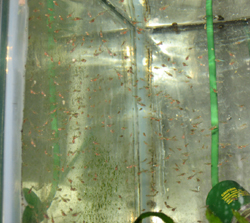
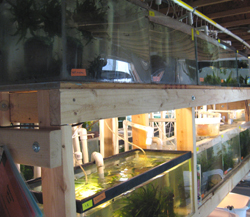
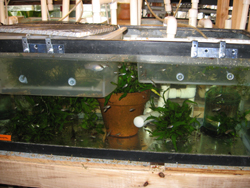
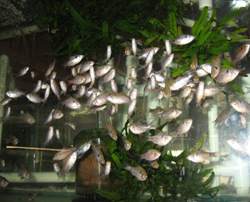
Click on each pic at left to enlarge.
Hybridizing
-Many of the livebearers will hybridize with other members of the
same genus. Pet store red
swordtails are the product of careful hybridization between the
X. helleri (wild swordtail)
and Poecilia maculata (a wild platy), done many years ago in the
early years of the hobby.
Most swordtails found commercially in pet stores today are hybrids.
As well, X. montezumae,
for example, will cross with the X. helleri and
X. alvarezi also
found at this site. The
goodeids will also hybridize, though the offspring produced are
often infertile,
as is the case with many crosses.
When you wish to create a hybrid between fish of different species,
there are obstacles
to be overcome that make the process more difficult than might be
expected. A female platy
released into a tank of helleri swords, for example, is no
guarantee of platy/ swordtail fry.
Beginning with the work of Glen Takeshita in the 1960's and most
recently, Roy Levine at
Cornell University, artificial insemination of livebearer tropical
fish has been perfected
and used, but other means can be used first to encourage
hybridization.
A male will prefer a female of their own species over a female of
another, even closely
related species. The gonopodium structure in males of even closely
related species can
differ substantially from males of other species, and this
structure is used as a means
to identify species- the structures are consistent, and may make
insemination between
separate species difficult or impossible. If you are determined to
cross two species
that are not known to cross, this may be the reason. Some who have
created hybrids from
a number of species, and who may be looking for specific traits, may
prefer the male to be
of one species and the female to be the other. This can only be
determined through practice,
depending on the trait you are breeding for and the results that
you receive. Generally
breed the fish you wish to cross in trios (One male, 2 female), and
possibly have two sets
(male of one, females of the other) going at the same time to
compare results. And be
patient- establishing a trait can easily take years..
Lastly, the traits you are hoping for may only appear in a few of
the fry produced, so
all young should be raised with extra care so that each fry
produced can be raised up
and evaluated. Then choose the healthiest individuals as breeders
for each generation.
Be aware that hybridizing for the sake of doing so is generally
frowned upon, as you
don't want the hybrids getting out into the hobby as pure species,
so breed and release
them carefully!
Mutations
Mutations occur far more frequently than people assume. The secret
to mutations doesn't
involve increasing the liklihood that a mutation will occur, but
instead, developing mutations
comes down to carefully collecting and raising as many
fry of every
spawn as possible, so
when a mutation appears you don't miss it. Occasional
albinos and
leucistics, because they
are obvious in a group, don't survive long in the wild and rarely
escape being picked
on in the aquarium. In fact, albinism, when it first appears, may
also affect the animal
in other ways. Albino mutations generally need to be isolated
immediately, not only for their
safety but because they are often smaller and may have other
problems, such as air bladder
development issues that they will need to recover from. The most
common mutations are various
degrees of leucistic appearance (where they may be almost
transparent, white, cream colored,
yellow, gold, or grey colored with various degrees of absence of
normal markings, all with
black, normal eyes) These fish are often hardier and more
consistently fertile than albinos.
(The alfaro cultratus, for example, produces an amber leucistic
fish with strange, nearly
all silver eyes that are generally all males. However, these amber
colored males and females
produced so far have been infertile.) The next would be number of
stripes differences,
edgings or bars appearing or that are missing, intensity of color
variations, and lastly, fin
extension mutations. Especially large or small sizes are not
considered mutations but
expressions that are normal within the genetic makeup of the fish.
In the few rare times
when large or small size was well beyond the normal genetic
expression, and truly a
mutation, the fish that resulted were infertile.
Not all mutations occur in all fish at a set rate. Certain species
produce albinos fairly
routinely, some very rarely, and some may never. For example, the
wild line of X. alvarezi
throws albinos regularly and has for over 20 years. Though the
albino line is kept separate,
the wild line still continues to produce them. The
X. helleri has
produced albino mutations
that are well represented in the hobby, and an albino
X. mayae
occurred here about a year ago.
I had bred and raised up about 1000 of them to get that first
albino, which is not very many
when each drop numbers about 30 to 40 fish. In contrast, the
X. montezumae has yet to produce
an albino, though each of these species are within the same genus.
I am also waiting for an
albino Odessa barb, or better yet, a gold (leucistic) fish that
will continue to possess
the black markings in the fins with the intense red stripe. But of
the many thousands
produced here in the last 5 years there have never been any
albinos, or any degree of
leucistic coloration in any of the Odessas.
The process to increase your liklihood of getting mutations is
simply to raise large numbers
of a species that are kept as healthy as possible, where females are
removed when gravid into
comfortable, smaller breeding tanks with lots of fine leaved
plants
for the fry to hide in.
(Java moss is perfect). With livebearers, the females are removed
from the breeding tank as
soon as you notice she has slimmed down, or fry can be seen
swimming in the tank. Most
livebearers will drop their fry between sunup and noon. It takes
about 45 minutes for a female
to have her fry, so generally, if you see one, you can assume she
has already dropped the
entire batch. If you are not sure, place her in another small
container to finish having her
fry, or check back on her in about a half hour. Carefully remove a
majority of the plants,
and start feeding prepared newly hatched
baby brine shrimp, later
followed by 50% daily water
changes if a 5 gallon or less size tank is used. After 1-2 days,
move any albinos, odd colored
fish or alive, but less healthy fish to their own breeders at this
time to raise separately.
For more information on raising mutations, such as how to breed to
develop a trait, click here.
_______________________________________________________________
Most fish will breed, but it is the raising of the
fry that
matters. Fortunately, livebearer young,
particularly the goodeids, are the easiest of fry to raise.
Of the fish offered at this site, some may spawn only 5 to a dozen
at a time, (Many of the goodeids,
such as Z. tequila). The
Odessa barbs spawn hundreds, but the
process is far more involved and
labor intensive to get more than a small percentage of the fry to survive to
adulthood.
With the swords, the trick is to get as many of the
young as
possible into their own small tanks where
they can be monitored and fed properly. With all of the fish,
water
quality for the fry and proper
food, when they need it, are the biggest issues to deal with.
Your experience will begin with what's written here, but what makes
it challenging and interesting is
that your conditions- water parameters,
filtration,
water changes,
type and amount of food fed,
temperature,
light, and of course the
species you choose to work with will
dictate your experience.
At first young may die, particularly with the
barbs. All that a
pair needs to do is produce 2 adults
over the course of their entire life. Life is both tenuous and
fragile when you are a new fry. As a
breeder you must learn how to keep them going in spite of the
tremendous odds going against
them. To pass on the information I have accumulated, I have
broken down the specifics to two
essays:
Breeding the Livebearers Found at
This Site
Check out the
Section on Breeding the Puntius padamya "Odessa"
Back to Previous Tip
To Next Tip
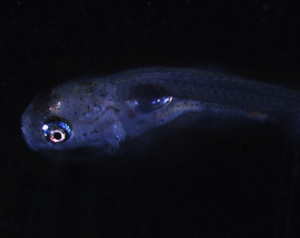
A 4 day old Puntius padamya "Odessa" barb. Notice its
heart just ahead of the left lower portion of the air bladder.
Home
Contact Us
Receiving Shipped Fish
Keeping Select Aquatics Fish
|
 |