|
Select
Aquatics |
|
|
|
|
|
|
|
|
Many of us have ordered fish from someone, they finally arrive,
you get them into a tank,
and two weeks later their numbers are down, and you can't figure out
why. I can't address
every time a fish dies when introduced to a new environment, but there
are a number of
factors that could be responsible. I'll try to mention a few things that
have worked best
for me. See "New Tank Syndrome" below, and also
Keeping Select Aquatics
Fish.
Select Aquatics does not charge extra for shipping or handling. We use
USPS Express or
or Priority Mail (For hard goods). The fish are shipped in
styrofoam boxes, individually impulse
sealed or knotted within breather bags . A quote is provided
when you order that is an
estimate based on the number of fish you order, the likely sized
box they will require,
and your location. The actual cost is not known until they
are bagged, sealed, and the
box is weighed at the Post Office.
A signature is always required for overnight deliveries unless it is
discussed in emails
beforehand.
I have a policy where if I overestimate your cost of shipping by more
than $6, I will refund
the difference back to you, and will absorb the difference when it costs
more to ship than what
you had been quoted. Customers are never overcharged for shipping. In
colder temperatures,
$3-5 may be added to cover the cost of 1-2 heat packs, which will be
stated in the initial
quote. As the overall weight, size of the box, and distance from Denver
increases, the postal
rate increases incrementally.
Shipping is
done when temperatures here and at their destination are between 35 and
90
degrees. If temperatures are not appropriate, I will check your
temperatures each weekend
for the upcoming week, and email you each week with a shipping date or
decision to wait
another week.
I care that your fish arrive as safely as possible, and that they do
well after they arrive.
I believe we have a responsibility to ensure that the fish do well once
they arrive in your
aquarium. Much information is provided here that I recommend you access,
particularly
the Care Guides linked from
each species page, as well as the broad overviews at
Keeping Select Aquatics Fish.
If they don't do well, I want to know, and if it can be
connected to a practice we are doing here, it will be addressed.
The shipping process is also constantly being improved upon, and losses
are the rare
exception. I ask that everyone let me know when a box is received,
when it arrived, and the
condition the fish are in to fix any issues, and ensure shipping quality for following
orders.
Please
contact me if the fish have difficulty, and specifics as to the
food, temperatures, feeding
schedule, etc. can be provided, as well as an effort to determine where
the fish ran into problems
if they occur.
I will generally send an extra or more (depending on the size of the
order) of each species ordered
to hopefully cover any losses that may occur during shipping. There are
some species where extras
cannot be sent due to the type of fish or the numbers here, such as the
sexed Green Dragon plecos.
More information on Select Aquatics shipping can be seen
HERE
A video on Select Aquatics Shipping can be seen
HERE.
|
 |
|
|
|
Overnight Express or 3-5 Day Priority Mail?
Due to losses that resulted from boxes shipped USPS 3-5 day Priority, through
no fault of
Select Aquatics or the customer, Select Aquatics no longer ships
3-5 day Priority Mail,
and now only ships USPS Overnight Express Mail. Further changes to
Paypal policy
begun Spring 2017 conclusively ended 3-5 Day Priority shipments
of live fish. All Hard
Goods - Pleco caves, Fertilizer, Levamisole, etc., are
shipped USPS 3-5 Day Priority.
Besides the obvious advantages of a box of live fish arriving
overnight, or 2nd day to some
areas, shipping cost for Overnight Express is determined by
weight only - so larger boxes
can be used for better care of the fish, at no extra cost.
Can I Ship Hold For Pickup?
Absolutely, and this is Highly
Recommended! The Postmaster here introduced me to
specific Hold For Pickup paperwork, where you would simply
follow tracking and pick up
the box at your convenience from your local Post Office. This
way the box does not spend
the day in an overheated or cold Postal truck going out to
delivery. Everything is arranged
when shipped, and I will need a contact Phone number from you.
the Post Office will often
(but not always) call you when the box arrives. When
following tracking, be sure to enter
the entire tracking number, including the first and last
letters.
Also, with Hold For Pickup delivery, when your Overnight box is
actually a 2 day delivery,
you will often be able to pick up your box the next day, as it
will be held for you, and not
prepped to be loaded to go out to truck delivery the next day.
Important: How close your home is to the Post
Office has nothing to do with whether your
box will be delivered any sooner than the guarantee time. Most
Post Offices deliver few
overnight boxes, and they will generally deliver them just
before their guarantee times.
Approximately 75% of the time the box is guaranteed by 3 pm. The
other 25% by noon.
When is Overnight Actually 2nd day?
Not all Overnight Express deliveries
will arrive the next day. Also, USPS (The Post Office),
does not offer a 2nd day shipping service. However, if you are
located a distance from a
Sorting/ Disribution facility, or from an airport receiving USPS
flights, your guarantee may
be for the 2nd day. You cannot choose to have a box spend 2
days, and the price is the same
as to ship Overnight.
From here, (Denver area), for example, Most Overnight deliveries
to Ft. Lauderdale will arrive
by noon the next day. Alberqueque, most of Kansas,
southern Colorado are 2 day deliveries,
because they must be shipped by truck. Most deliveries to
northern Washington State are also
2 day deliveries from here. If the delivery day is especially
important, I can check ahead of time
as to whether you are a 2 day, as opposed to overnight delivery.
|
|
|
|
Receiving Shipped Fish:
1. When preparing to receive new fish, I have an empty tank prepared for
them to acclimate
to, with plants to hide in, possibly a very thin layer of gravel, a working
filter, a top that
provides full cover from jumping out, a heater (if necessary), and no or
low light. After
opening the box, but before opening the first bag or container, test the
pH and and hardness
of the water the fish have arrived in. That way you will know how far
"away" your water is
from what the fish are accustomed to. This dictates the speed of the
acclimation process, and
tells you whether you may need to add anything to the water to make it
softer, harder or adjust
the pH.
2. Then, when introducing any fish to a new source of water, drip
acclimate. Drip acclimating
is simply this:
Open the bag or container the fish came in and empty it into another
empty open container,
such as a "shoebox" style plastic box. If need be, tip the new container
(If new, rinse thoroughly
first- of course, no cleansers), up at one end to allow the fish to be
covered by the water they
came in. Then set up a length of airline tube from an established
aquarium or container of your
dechlorinated water to a plastic air valve, going into the water the
fish were shipped in so that
a drop falls in about every 3-5 seconds. I have seen some fishkeepers
that will simply tie the
airline into a loose knot to accomplish this. Be sure to cover the
container so that the fish
cannot jump out.
Keep an eye on it, and watch the fish for any signs of distress every
few minutes. If they begin
to act oddly, turn off drip and wait 20 minutes or so before resuming.
When you have doubled
the amount of water they came in, you can then begin to slowly increase
the flow rate. The
entire process should take at least an hour, for they need to be given
time to physically
adapt, particularly if the pH or hardness differ by more than a slight amount.
I have heard that there are some fishkeepers that do not advise adding
fresh water to bag water,
claiming it can actually be more harmful than to simply dump them right
in. In my experience this is
a false belief, and will definitely cause more harm than good. I am
aware of the ammonia to
nitrate concerns they mention to defend this position, but do not think
is is more than an
interesting take on the process, and doesn't apply to the small amounts
of water we are working
with. As well, I have witnessed too many fish that succumbed from pH or
temperature
shock over the years from an insufficient acclimation to ever consider
anything other than a long,
gradual, relatively stress free acclimation to their new water.
3. Then put them into a bag to be floated, or float that container,
possibly with a little baby brine
shrimp for them to eat, for 10-15 minutes to even out the temperatures.
If they are being put into
a tank with other fish, be sure to feed the other fish well so that they
will be less likely to nip or
bother the new tankmates. When one fish meets another, it has only 3
concerns- Will you eat me,
do I want to eat you, and/or can we mate with one another? Feeding
everyone well removes two
of those options. If you take this opportunity to give them some BBS
before being released, be
sure to release them after no more than an hour, for the BBS will foul
the small amount of water
they are in and possibly kill the fish if left for too long.
Then slowly let them go into the tank, keeping the light off, a cover on
the tank (fish will be less
likely to jump out later, once acclimated.) Once they settle, introduce
the light and lightly feed
some dry food. If quarantining them in a transition tank, keep them in
that tank one week, then,
assuming water conditions are the same where they are going, float
them about 10 minutes to
ensure the temperatures are equal before letting them go into their new home.
_________________________________________________________
"New tank syndrome" - What it is and how to avoid
it:
Fish emit wastes through both digestion and respiration, far more than
what can be seen by looking
at the tank. In an established aquarium, bacteria that have built up
over time process that waste,
and as long as waste is not produced faster than the bacteria can digest
it, the tank stays stable.
By stable I mean that toxic substances (such as ammonia, nitrites,
nitrates) do not accumulate.
Those substances, when allowed to develop and build up, will quickly
kill fish.
"New tank syndrome" is simply a fresh body of water being inundated with
wastes it doesn't yet have
the bacteria to process. Lethal amounts of toxic substances accumulate
during normal biological
activity, and the fish die. The average time for a tank to "crash" is
understood to be 15 days. But
there are a number of solutions-
The best solution is to start a new tank with water from an established
tank, filling the new tank
at least 10% with the seasoned aquarium water. Add dechlorinated tap
water and you are ready to go.
The next best option is-
- Get water from a disease free established tank at a friend's or from
the local fish store.
Anyone keeping fish successfully must do regular water changes, so water
should be always
available. Just be sure the tank the water comes from is disease free!
- This next solution works well, without the need to get water from
anywhere else. Before obtaining
or adding the fish, fill the tank with dechlorinated water and a light
sprinkling of dry food, and
if possible, have it sit for awhile- a few days- with the filter or an
airstone going. When everything
is ready for the fish (the water is totally clear, filter is added,
heater, etc.), go ahead and put
them in, and feed fairly lightly the first few days.
Here's the important part. Take out and replace about 20% of the water
every 3 days for the first
2 weeks. This allows the bacteria to develop over those first 2 weeks
while preventing a buildup that
will adversely affect the fish. If the tank ever becomes cloudy, change
10-20% at those times as well.
At about 3 weeks you can then go to a normal 20% once a week water
changing schedule. Never get into
the habit of simply adding water to a tank simply to replace water that
had evaporated. By doing so
you are actually concentrating toxins in the water that need to be
removed. Also see "3 Periods of
Fish Adjustment". |
|
|
|
|
If a Fish arrives DOA:
This happens rarely, and I will make every effort to ensure that your
fish arrive healthy. If a fish
does arrive that has died in transit, extras are sent in most cases, and
on only a couple occasions,
of many hundreds of boxes shipped, have the losses exceeded the extras.
But if that does happen,
I definitely want to know about it! Please send me a pic of the
deceased fish as soon as they
arrive to selectaquatics@gmail.com , and I will replace your fish at no
charge (If available), but
the customer will pay for shipping.
|
|
|
|
 |
|
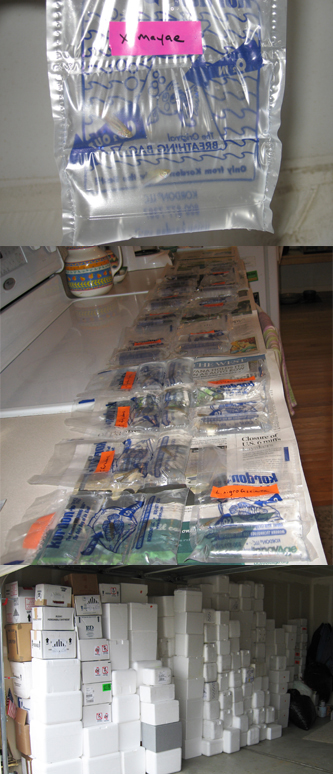
Each fish is shipped in either impulse sealed
channels in breather bags, or breather bags
that are knotted in the normal fashion, or
standard doubled plastic bags for fish with
spines that may puncture the breather bags.
Gradual improvements to the packing process
have caused losses to be minimal. Extras
continue to be sent of most fish with each
order, so that the customer always receives
at least what they ordered.
After being
caught and sealed into the bags, they
are checked for leaks over newspaper while the
styrofoam boxes and paperwork is prepared.
If a leak is seen, the fish are removed and the
bag
is replaced.
Styros waiting for a delivery!
|
|
|
|
|
|
|
|
|
|
|
|